Skip to content

study for a landscape
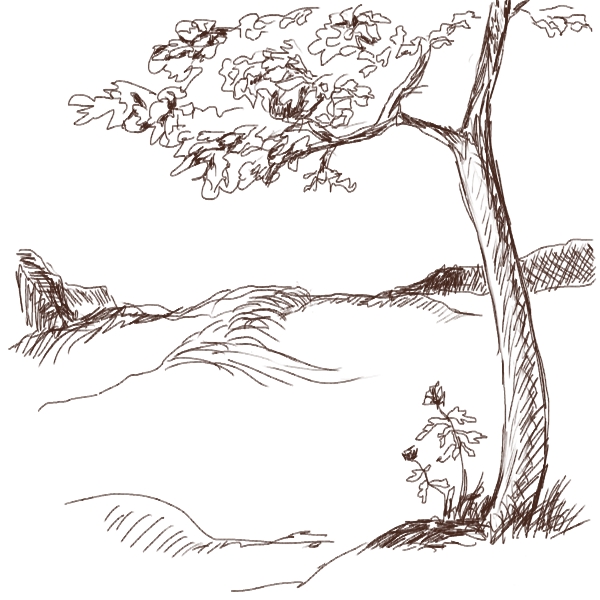
This sketch is the ninety-ninth in a 365-day challenge to draw a picture a day, every day, for a year…

Day ninety-nine: I’ve been looking at 16th-century Dutch landscapes all day while working on my paper. The use of a tree to anchor the scenes perspective and direct the viewer’s eye into the distance was a typical device used by artists. Sometimes the foliage arches over the scene, creating a natural frame for the setting. This sketch fleshes out a similar composition. Practice for a more finished landscape drawing in the future.

Tagged , , ,

workspace(s)

This sketch is the ninety-eighth in a 365-day challenge to draw a picture a day, every day, for a year…

Day ninety-eight: Whoops! Getting this posted just under the wire. I am preparing a paper to present next Friday at an art history conference, a project which has distracted me all evening. So in a hurry, I decided to sketch the two work spaces I used today into one picture. My digital pad and pen that I use every day to make these drawings is on the desk along with my computer, a few books, and one of the 17th-century prints I’m writing about.

Tagged , ,

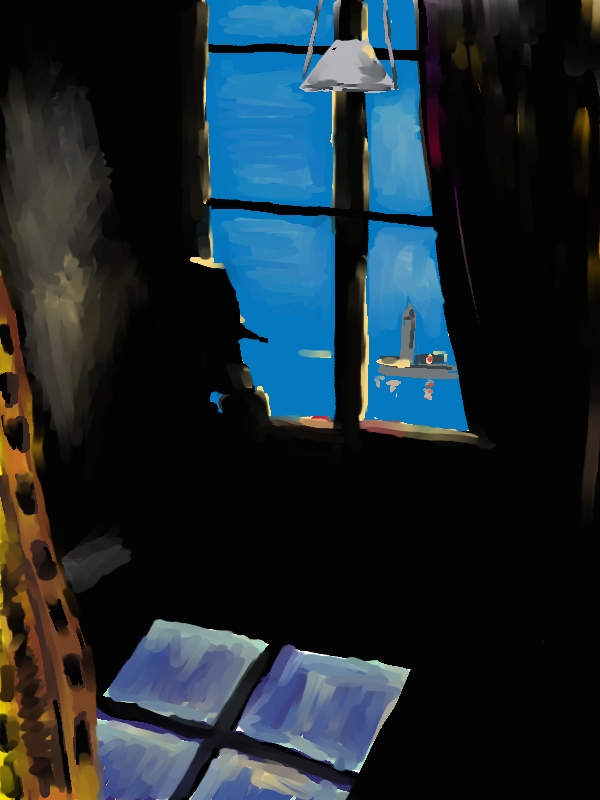
night window

This sketch is the ninety-seventh in a 365-day challenge to draw a picture a day, every day, for a year…

Day ninety-seven: This quick sketch is inspired by Edvard Munch’s oil painting “Night in St. Cloud” at the National Gallery in Oslo. Painted in 1890, Munch’s original is more rich with subtle shades of color than what you see here. What I appreciated most on an evening when I needed to finish my drawing quickly, is how effectively Munch’s simple design conveys atmosphere and mood with a minimum of brush strokes.

Tagged , , ,

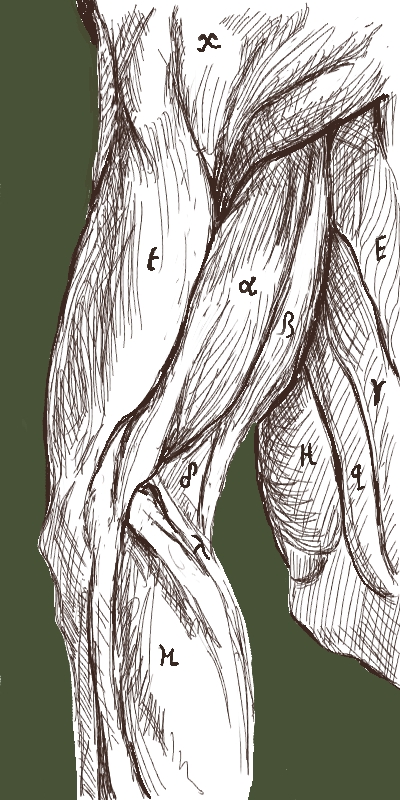
leg muscles

This sketch is the ninety-sixth in a 365-day challenge to draw a picture a day, every day, for a year…

Day ninety-six: Yesterday’s workout made my legs extremely sore today, especially my quadriceps. I can barely walk down the stairs without wincing. The idea of drawing my leg muscles led me back to Vesalius’s anatomical atlas to sketch another of the book’s woodcut illustrations. This detail is taken from one of the so-called “muscle men” who appears on page 174 of the 1543 edition. I appreciate how the artist who created the original picture curved the lines to form the shapes of the muscles.

Tagged , , ,

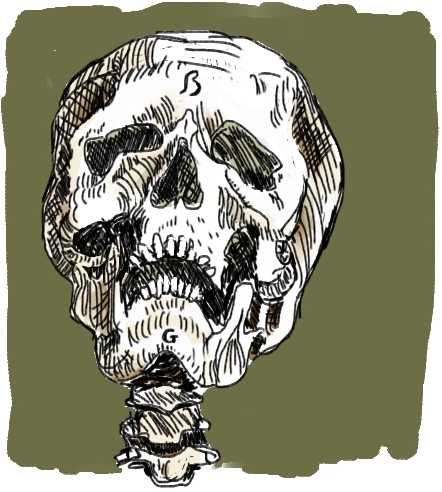
anterior view of a skull

This sketch is the ninety-fifth in a 365-day challenge to draw a picture a day, every day, for a year…

Day ninety-five: One more day looking at old woodcuts. This skull is modeled after a skeleton depicted in the 1543 edition of an early anatomical atlas written by Andreas Vesalius titled, De humani fabrica libri septem. Although Vesalius’s treatise and its illustrations by anonymous Venetian artists mark a turning point in the accuracy of books on anatomy, my quick sketch has devolved a little from the original. Still, it’s the most accurate skull I’ve ever sketched. The letter ‘G’ on the chin and letter ‘ß’ on the forehead relate to points of information in the text. The added color is a whim of my own.

Tagged , , , ,

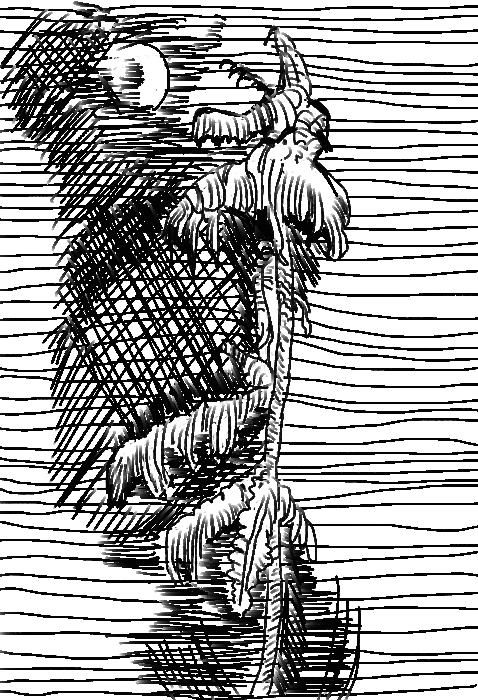
altdorfer pine


This sketch is the ninety-fourth in a 365-day challenge to draw a picture a day, every day, for a year…

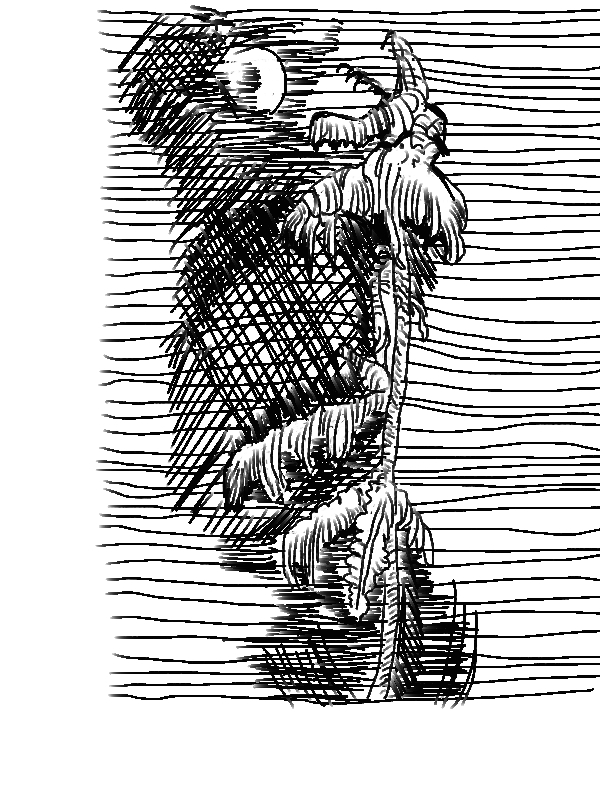
Day ninety-four: Continuing the woodcut theme for a second day, this pine tree is based on one by German printmaker Albrecht Altdorfer. It’s from a series of forty tiny woodcuts narrating “The Fall and Redemption of Mankind,” made around 1513. Each highly detailed and complex composition is about 3 x 2 inches. Altdorfer is believed to be one of the first Western artists to produce pure landscapes, and this series incorporates landscape elements to create dramatic atmosphere. After I roughed in the basic shape of the tree, I began to explore contrast more spontaneously. Although my lines are not as tidy and the night sky isn’t filled in fully, the effect is similar.

Tagged , , ,

woodcut mule

This sketch is the ninety-third in a 365-day challenge to draw a picture a day, every day, for a year…

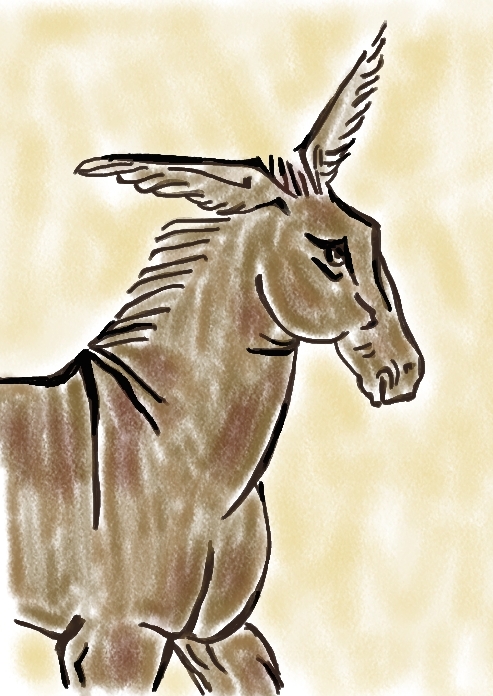
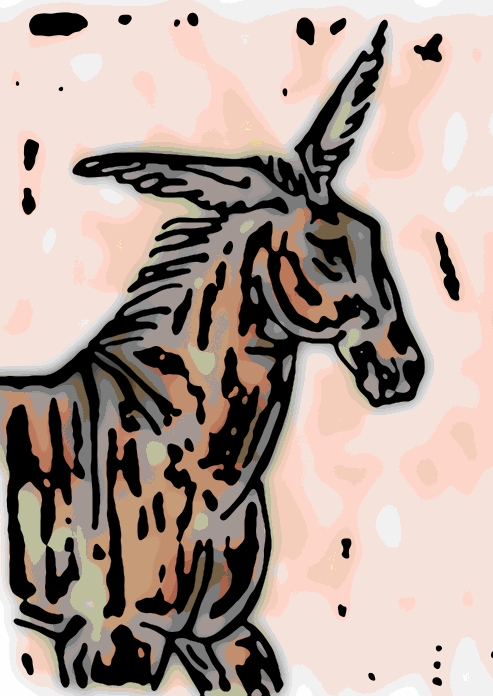
Day ninety-three: Paging through a book about the woodcut in 15th-century Europe, I browsed upon one of Christ’s Entry into Jerusalem from c. 1440-1445 with traces of faded color. The mule caught my eye. In the original the beast looks kind of grumpy. I love the simplicity of early European woodcuts that predate the use of cross-hatching. Interplay between the artist’s pen and the wood cutter’s knife creates a unique style of curves and angles. On a whim, I used Corel’s “woodcut” trick to see what would happen,  hoping that it would look like my drawing had actually been carved into a block. Contrarily, the computer program took a much more modern approach, I think, by translating the 15th-century lines into forms that might be preferred by an early 20th-century Expressionist.

Tagged , , ,

sculptural? Roman fresco

This sketch is the ninety-second in a 365-day challenge to draw a picture a day, every day, for a year…

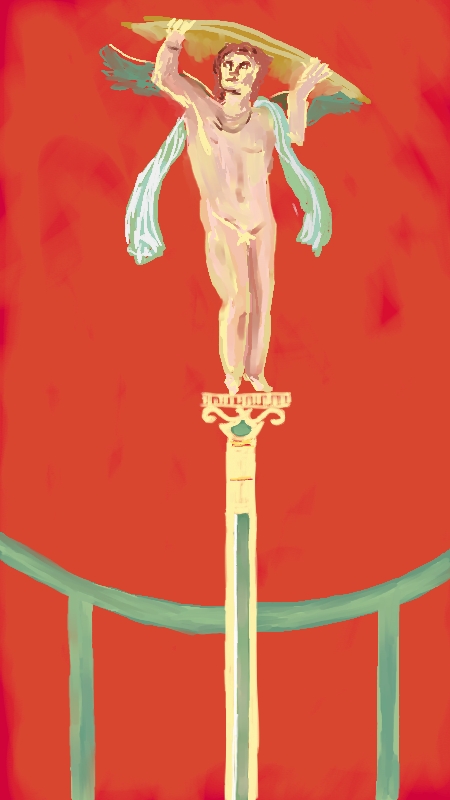
Day ninety-two: Today’s rapid sketch continues the ancient Roman sculptural theme, but this time looks at Roman fresco painting. This slightly pudgy figure with stubby feet is based on a fragment from Ercolano, now in Naples. It struck me during the lecture on sculpture in Renaissance painting the other evening that the Romans painted sculptural figures into their decorative wall motifs. What is curious is that these figures posing on pedestals and built into fanciful architecture are painted to appear living and flesh-like, not like bronze or stone. I can think of a variety of possible reasons for this, none of which I’m going to research now. I’m going to call this the sketch of the day, and go watch an episode of “Rome.” 😉

Tagged , , , ,

bronze eye

This sketch is the ninety-first in a 365-day challenge to draw a picture a day, every day, for a year…

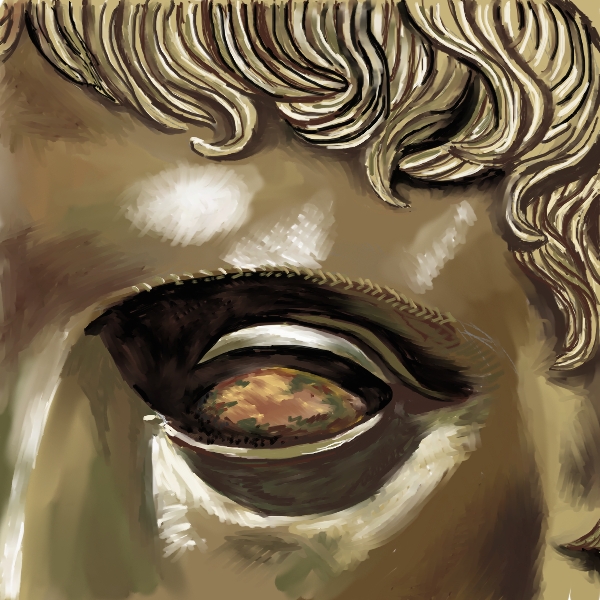
Day ninety-one: I wasn’t entirely satisfied with the result of yesterday’s drawing, though I thoroughly enjoyed studying the bronze and playing with the colors to create a sense of patina. Today, I have made a second attempt at the same bronze sculpture from the Villa of the Papyri. This time focusing on a detail of one eye, a bit of nose, and some hair. It was the hair that I really had hoped to master, but found to appear truly natural it requires a bit more patience and a steadier hand than mine. Still, I think the drawing turned out well overall.

Tagged , , ,

painting sculpture

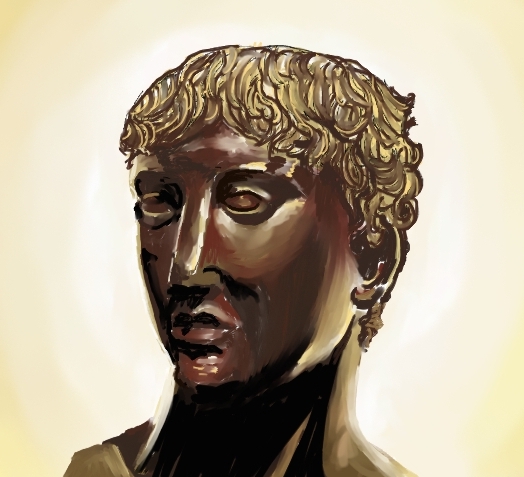
This sketch is the ninetieth in a 365-day challenge to draw a picture a day, every day, for a year…

Day ninety: This evening I attended a lecture at the Minneapolis Institute of Arts about sculpture and the sculptural in Renaissance painting. The topic begged, of course, for me to paint a sculpture for today’s drawing. I chose an ancient Roman bronze bust now at the National Archeological Museum in Naples. I believe it is from the Villa of the Papyri in Ercolano, near Pompeii.

Tagged , ,